
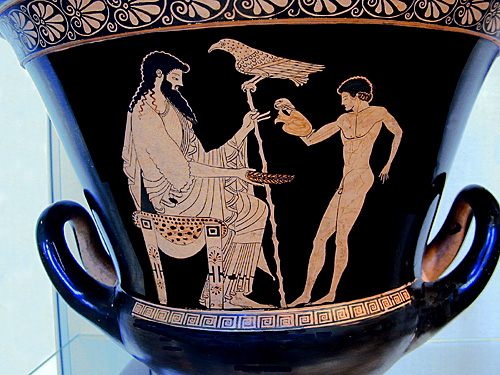
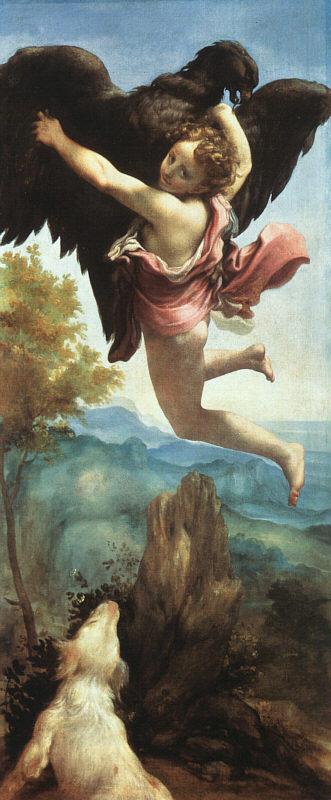
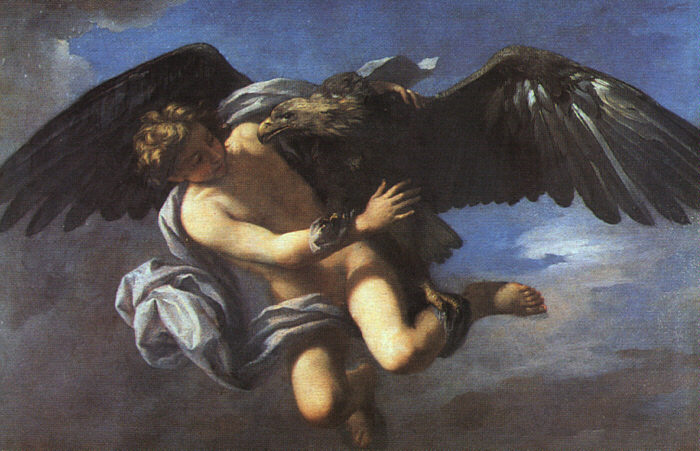
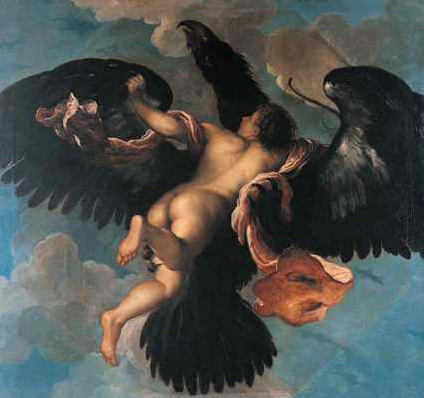
So. Ganymede. Jupiter's largest moon. Which are named after... girlfriends, right. Io, Callisto, Europa, Ganymede. Ganymede's the odd one out. He's the boyfriend. According to the myth, he was kidnapped while hunting or tending sheep by a great eagle, usually said to be Zeus in bird form but which sometimes is merely Zeus's servant. Zeus (or Jupiter, or Jove) fired Hebe, the cupbearer of the gods, and put Ganymede to work in her place. Hera was so angry and jealous that he was eventually turned into the constellation Aquarius.
Mentioned in passing in the Iliad, it makes him one of the older myths in the repertoire. He appears in a discussion of the ancestors of Hector: "In the beginning Dardanus was the son of Jove, for Ilius was not yet established on the plain for men to dwell in, and her people still abode on the spurs of many-fountained Ida. Dardanus had a son, king Erichthonius... Erichthonius begat Tros, king of the Trojans, and Tros has three noble sons, Ilus, Assaracus, and Ganymede who was comeliest of mortal men; wherefore the gods carried him off to be Jove's cupbearer, for his beauty's sake, that he might dwell among the immortals." (This makes him Zeus' great great grandson, for those of you keeping score at home.) It's been variously argued that Homer did not intend their relationship to be a sexual one. One of my sources contains this quote from another historian: "the earliest surviving testimony to Zeus' homosexual desire for Ganymede is Ibykos, where the ravishing of Ganymede was put into the same context as the rape of Tinthonus by Dawn, who did not want a wine-pourer [but a sexual partner]."
Where did he come from? Plato says in his Laws, "The Cretans are always accused of having invented the story of Ganymede and Zeus, which is designed to justify themselves in the enjoyment of such pleasures by the practice of the god whom they believe to have been their lawgiver." I wasn't sure if this had reality behind it, or was another case of Everybody-Blame-Crete. Percy, the author of Pederasty and Pedagogy linked above, says "The number of ancient writers who support, directly or indirectly, a Cretan birthplace for pederasty is impressive" but names no names. Traditionally the boy is said to have been taken from Mount Ida near the city of Troy, but the Chalcidians claimed he was abducted from Harpaigon, a myrtle grove near their city. Here's a good list of ancient references.
The boy appears in later Greek poetry as a measure of the beauty of the mortal boyfriends of poets. Sometimes the fear is expressed that Zeus will trade one for another:
If Zeus is still the god who kidnapped Ganymede
to have a boy to bear the cups of nectar,
then I will hide the fair Myiscus in my heart
before the god eludes me and swoops down on him.
--Meleager (Musa Puerilis, Greek Anthology)
And, of course, he shows up many times in Greek art.
Ganymede's Roman name is Catamitus. (Those of you with large vocabularies can sort of see where this is headed.) Roman Homosexuality has a section devoted to the Romanization of the myth, starting with his appearance in Etruscan mythos as Catamit but quickly moving onto two mentions of him in Virgil's Aeneid: once near the beginning in a list of reasons Juno is so angry at the Trojans, and again appearing decorating the cloak given to Aeneas as a prize at Anchises' funeral games. The casual noun form (catamite) of Ganymede's name was used by Cicero to insult Marc Antony. Hadrian's equally famous boyfriend Antinous and Domitian's eunuch Earinos were frequently compared to him. He had already become a type of his own: "...the figure of Ganymede appears throughout Roman literature as the archetype of the beautiful, sexually desirable male slave as prerequisite of wealth and privilege..." (Williams 56) Martial twice irreverently calls Ganymede "the Trojan cinaedus", assuming not only his sexual services but also effeminacy, which would be seen again later.
Williams says Ganymede was "extremely popular" in Roman art, but this is about all I can find linked on the Internet, sorry. Many of the statues may have been copies of Greek originals in any case (there was one placed in the Forum at one point).
This is an 18th century translation by Thomas Heywood of Plutarch's Dialogue concerning Zeus and Ganymede; my favorite version, but read it anyways, because it's comedy gold.
There is a column depicting the Rape in the Cathedral of St. Madeleine de Vezelay in France, built in 858.
Ganymede shows up again in a twelfth century dialogue between he and Helen: heterosex or homosex? Helen wins so the moral can be delivered properly, with the argument that sodomy is murder because of the sperm wasted. Ganymede is portrayed as haughty, selfish, mercenary, and viciously misogynistic. Helen calls him a monster, and Nature is angry that he dares enter the palace because "She considers him neither her son nor her heir". At the end, having lost the argument, Ganymede asks for Helen's hand in marriage.
Our Hero returns with a vengeance in the Renaissance. Many artists drew, painted, or sculpted Ganymede and the eagle as a matter of course: Michelangelo, Cellini, Correggio, Gabbiani, Peruzzi, and Mazza, to name a few. Cellini actually defended himself against the charge of 'sodomite' with the bold statement: "...would God I knew how to practice such a noble art, for one hears that Jove used it with Ganymede in paradise, and here on earth the greatest emperors and kings in the world use it." (Roche, Forbidden Friendships, 136)
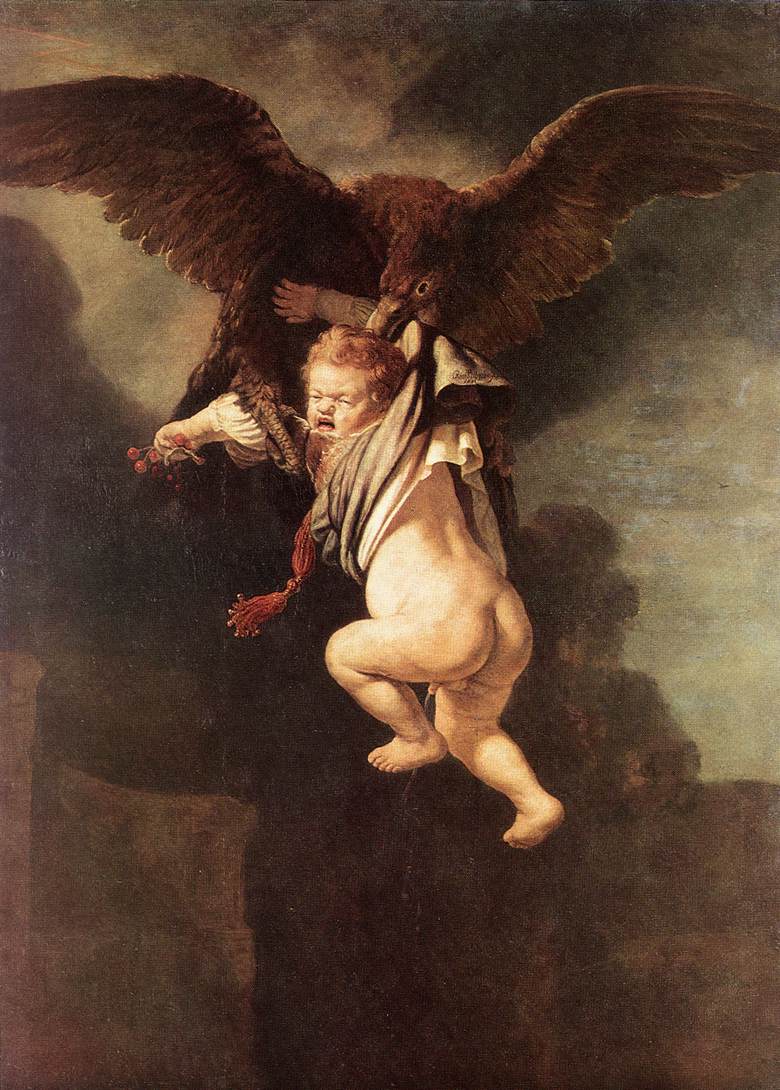
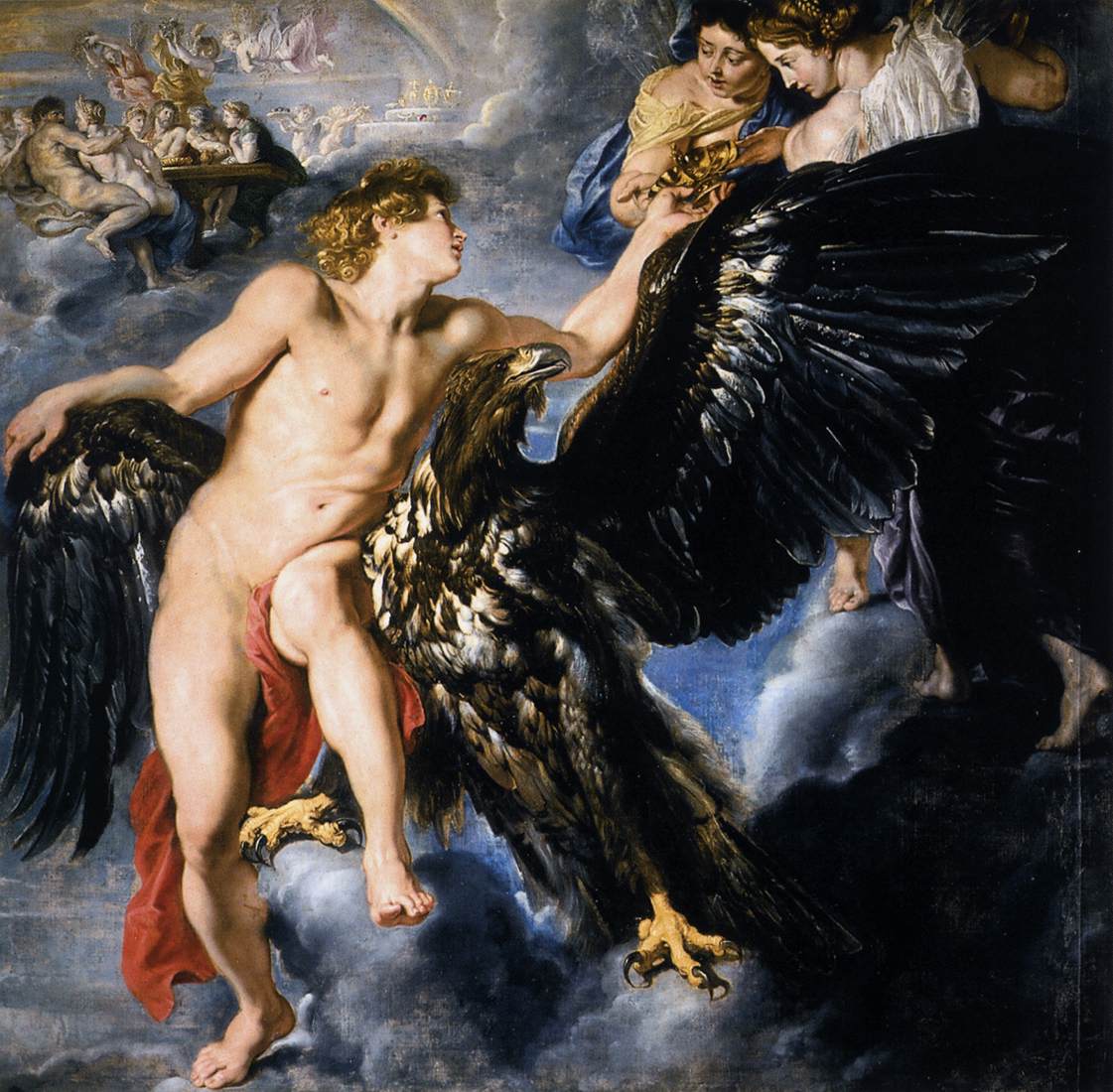
Rembrandt did a painting of Ganymede- but his version clearly indicates his own thoughts on the subject. Rubens did two different versions of the boy and eagle.
So much for the paintings. In England, the boy we're following shows up in the literature: In Shakespeare's As You Like It Rosalind disguises herself as a boy, calls herself Ganymede, and is flirted with by Orlando. In the poem Venus and Adonis, Venus is described in active masculine terms, and at several points the comparison to Zeus's eagle and Ganymede's passivity is brought to the surface:
"Even as an empty eagle, sharp by fast,
Tires with her beak on feathers, flesh, and bone,
Shaking her wings, devouring in all haste,
Till either gorge be stuff'd, or prey be gone;
Even so she kiss'd his brow, his cheek, his chin,
And where she ends, she doth anew begin.
...
Upon this promise did he raise his chin,
Like a dive-dapper peering through a wave,
Who being look'd on, ducks as quickly in;
So offers he to give what she did crave,
But when her lips were ready for his pay,
He winks, and turns his lips another way."
Turning to Christopher Marlowe, the boy shows up most notably in his Tragedy of Dido, Queen of Carthage, in which he is portrayed as a prostitute trading gems for embraces in the very first scene. He is mentioned in Edward II by Isabella as she compares him to Gaveston ("Like frantic Juno will I fill the earth/ With ghastly murmur of my sighs and cries,/ For never doted Jove on Ganymede/ So much as he on cursed Gaveston.") and in the narrative poem Hero and Leander as Neptune mistakes Leander swimming across the Hellespont for Ganymede escaped from Olympus:
"Leander strived; the waves about him wound,
And pulled him to the bottom, where the ground
Was strewed with pearl, and in low coral groves
Sweet singing mermaids sported with their loves
On heaps of heavy gold, and took great pleasure
To spurn in careless sort the shipwrack treasure.
For here the stately azure palace stood
Where kingly Neptune and his train abode.
The lusty god embraced him, called him "Love,"
And swore he never should return to Jove."
The lesser known Elizabethan poet Richard Barnfield wrote the long homoerotic poem The Affectionate Shepherd (Containing the Complaint of Daphnis for the love of Ganymede.) There are no direct references to the myth itself aside from the name, but it's a potent reminder of the poet's intent by itself. A complete version is not available online, but here is an abridged version.
In Giles Fletcher's 1610 poem Christ's Triumph after Death, the people watching Christ's ascension to Heaven are compared to the frightened onlookers who witnessed the taking of Ganymede. The myth was Christianized further elsewhere by stripping it of sexual aspects and making it a metaphor for innocents in Heaven: "...the rapture of Ganymede had long since been widely spiritualized as a Christian allegory of the devout soul’s ascent to God. Indeed, as Leonard Barkan notes, Claude Mignault, the commentator on Alciati, goes so far as to align Jupiter’s love for Ganymede and Christ’s invitation to "Suffer little children to come unto me." Thomas Traherne used similar metaphors in his poetry to describe his relationship with Christ. (Rambuss, Queering the Renaissance, 273)
Make no mistake, "ganymede" was still used as a derogatory noun. (Somewhere there's a quote from an Elizabethan moralist about the "ingles and ganymedes" in the theater, but I can't find it. Expect an update when I do.) The English Earl of Sunderland, held partly responsible for the collapse of the South Sea Bubble in 1720, was portrayed in the vicious 1721 satire The Conspirators, or the Case of Cataline as immoral and vice-riddled: "'Tis certain, however odd and unnatural his Lewdness was, (yet it was a notorious Practise among some great men of that Age) and some of his Ganymedes were pampered and supported at a high Rate at his Expence." This is likely also a reference to Beau Wilson, who the Earl may have kept twenty years earlier before Wilson's untimely murder.
Samuel Drybutter (scroll down), "toyman" or merchant of books, jewelry, and other miscellaneous sundries, pilloried for selling copies of Cleland's Fanny Hill, was compared to Ganymede in several contemporary satires against him.
More miscellaneous art. One of the pictures on that page has the note that Ganymede was in fact used as a metaphor for the innocent being carried into Heaven, corroborated by my two sources above. I have not been able to find anything in depth on this subject- make of it what you will.
Ganymede used in early Budweiser commercial.
Gilbert, a character from the 1976 manga Kaze to Ki no Uta, dressed as Ganymede. Anyone who's read that series or seen the OVA knows what an apt comparison this is.
He's still alive and kicking in the collective imagination. He's used as a metaphor in Thomas Mann's novel Death in Venice. He's in works of fiction online. Keep a lookout, folks.
Showing posts with label lectures. Show all posts
Showing posts with label lectures. Show all posts
Saturday, August 11, 2007







Tuesday, August 7, 2007
Homosexuality and the Color Green
Sometimes you come across a reference that keeps popping up, here and there, in unexpected places. And even though it's being referenced, no one is actually talking about it at any length. I came across a 1974 interview with Barbara Gittings, one of the founders of the Daughters of Bilitis, in Katz's Gay American History. She mentions that in her search for material on homosexuality after she first realized what she was, "there'd be pop-level material which said "the homosexual's favorite color is green." That upset me, because my favorite color was blue." (pg 421, 1992 edition)
And then elsewhere in the same book, discussing a character from Helen R. Hull's 1923 book The Labyrinth: "Hull goes so far as to emphasize Margaret's green dress, green hat, green coat, green eyes, and green identification card, a color symbolism, no doubt intended as an "in" clue to Margaret's sexual orientation-- green being one of those colors traditionally associated with homosexuality." (pg 539) The footnote here discusses Oscar Wilde's green carnations and a 1933 Broadway play called The Green Bay Tree.
Green? Why green? I kept seeing it: Chauncey's Gay New York mentioned it several times: a man wearing a green suit in NYC during the 1920's could be beaten up or killed. Drag queens wore green dresses at the city's huge drag balls of that era. Cornelius Willemse, an investigator who infiltrated Bowery resorts and set up raids on gay bars, entitled his autobiography Behind the Green Lights-- a reference, also, to the theater, which at the time still used limelights.
Strangers (Graham Robb):
pg 59: “Medical concepts like ‘contrary sexual feeling’ and ‘the intermediate sex’ were the template for tales that could make sense of life in all its details: the shape of one’s hand, the behavior of one’s parents, a predilection for the color green.”
pg 151 (on tokens): “The carnation was a traditional symbol of the anus, and the colors green and red had a long association with homosexuality. Pinkness seems to have acquired consistently homosexual connotations only in the 1900s, but green had been a gay color for centuries. Effeminate men in Ancient Rome were called galbinati because of their fondness for the color green.” (The note here directed me to Martial and two works in French. Helpful, thanks.)
pg 226:“Edward Prime-Stevenson’s character Dayneford, in ‘Out of the Sun’ (1913), has a small library in his villa onCapri , its walls ‘tinted in the significant green’…”
Gay L.A. (Lillian Faderman and Stuart Timmons):
pg 59: “[Rudolph] Valentino’s style—his clothes, his grooming—were iconographically queer, and they created an absolute panic among homophobes, as a Chicago Tribune column revealed in 1925 when Valentino visited Chicago wearing what the writer sardonically described as “a symphony in green.”"
I went to other sources. They told me variously that green was associated with Venus and Aquarius (Ganymede- surprisingly telling), that a person who wore green on a Thursday during the 1960s was gay, that it was considered unlucky in various British traditions for being a faerie color or associated with the Celtic underworld, that it marks characteristics ranging from love, the "base desires" of man, witchcraft, the Devil and evil, loss of virginity or worldliness (Greensleeves), and prostitution. See this picture, or Chaucer, wherein the Devil wears green, not Prada.
I went to the library and dug up the artbooks. In medieval art, certain people wear green: witches and promiscuous women, Jews, people making fun of Christ on the cross, at least one of the Magi at any given portrayal of the Adoration, and (oddly) the apostle John in more than one portrayal of the Last Supper. The Beloved Disciple he may be, lover of Jesus in a certain distinctive medieval and Renaissance tradition, but as far as I was aware he was not usually portrayed as effeminate.
A friend I enlisted to help me dig for links turned up this version of the Hanky Code. Kelly green: hustler if worn on the left, john if worn on the right.
None of these discoveries are very surprising. Homosexuality has been associated with prostitution for quite some time, even looking at slang. "Gay" was originally attached to promiscuous women at the end of the 19th century. In the 18th century, a "quean" was a prostitute. The colorful phrases "he-strumpet" and "he-whore" were attached to gay men by people who could not imagine the sex practices involved being for fun rather than money. Going centuries earlier, sodomy tended to be lumped in with heresy and witchcraft rather than being a separate consideration-- look up the fate of the Knights Templar.
Why isn't the association with green around anymore? Gay men wear pink now, supposedly. Just watch Jeffrey. I only came close with this page, which claims that prior to WWII, pink was for boys (related to red, a strong manly color) and blue was for girls (suggestive of the Virgin Mary, and supposedly softer and daintier). I believe that part, the poster provides several magazine quotes from that time. But it does not really explain why Germany and unspecified "neighboring countries" switched and began associating pink with girls in order to label homosexuals in the Nazi concentration camps with the pink triangle.
And then elsewhere in the same book, discussing a character from Helen R. Hull's 1923 book The Labyrinth: "Hull goes so far as to emphasize Margaret's green dress, green hat, green coat, green eyes, and green identification card, a color symbolism, no doubt intended as an "in" clue to Margaret's sexual orientation-- green being one of those colors traditionally associated with homosexuality." (pg 539) The footnote here discusses Oscar Wilde's green carnations and a 1933 Broadway play called The Green Bay Tree.
Green? Why green? I kept seeing it: Chauncey's Gay New York mentioned it several times: a man wearing a green suit in NYC during the 1920's could be beaten up or killed. Drag queens wore green dresses at the city's huge drag balls of that era. Cornelius Willemse, an investigator who infiltrated Bowery resorts and set up raids on gay bars, entitled his autobiography Behind the Green Lights-- a reference, also, to the theater, which at the time still used limelights.
Strangers (Graham Robb):
pg 59: “Medical concepts like ‘contrary sexual feeling’ and ‘the intermediate sex’ were the template for tales that could make sense of life in all its details: the shape of one’s hand, the behavior of one’s parents, a predilection for the color green.”
pg 151 (on tokens): “The carnation was a traditional symbol of the anus, and the colors green and red had a long association with homosexuality. Pinkness seems to have acquired consistently homosexual connotations only in the 1900s, but green had been a gay color for centuries. Effeminate men in Ancient Rome were called galbinati because of their fondness for the color green.” (The note here directed me to Martial and two works in French. Helpful, thanks.)
pg 226:“Edward Prime-Stevenson’s character Dayneford, in ‘Out of the Sun’ (1913), has a small library in his villa on
Gay L.A. (Lillian Faderman and Stuart Timmons):
pg 59: “[Rudolph] Valentino’s style—his clothes, his grooming—were iconographically queer, and they created an absolute panic among homophobes, as a Chicago Tribune column revealed in 1925 when Valentino visited Chicago wearing what the writer sardonically described as “a symphony in green.”"
I went to other sources. They told me variously that green was associated with Venus and Aquarius (Ganymede- surprisingly telling), that a person who wore green on a Thursday during the 1960s was gay, that it was considered unlucky in various British traditions for being a faerie color or associated with the Celtic underworld, that it marks characteristics ranging from love, the "base desires" of man, witchcraft, the Devil and evil, loss of virginity or worldliness (Greensleeves), and prostitution. See this picture, or Chaucer, wherein the Devil wears green, not Prada.

I went to the library and dug up the artbooks. In medieval art, certain people wear green: witches and promiscuous women, Jews, people making fun of Christ on the cross, at least one of the Magi at any given portrayal of the Adoration, and (oddly) the apostle John in more than one portrayal of the Last Supper. The Beloved Disciple he may be, lover of Jesus in a certain distinctive medieval and Renaissance tradition, but as far as I was aware he was not usually portrayed as effeminate.
A friend I enlisted to help me dig for links turned up this version of the Hanky Code. Kelly green: hustler if worn on the left, john if worn on the right.
None of these discoveries are very surprising. Homosexuality has been associated with prostitution for quite some time, even looking at slang. "Gay" was originally attached to promiscuous women at the end of the 19th century. In the 18th century, a "quean" was a prostitute. The colorful phrases "he-strumpet" and "he-whore" were attached to gay men by people who could not imagine the sex practices involved being for fun rather than money. Going centuries earlier, sodomy tended to be lumped in with heresy and witchcraft rather than being a separate consideration-- look up the fate of the Knights Templar.
Why isn't the association with green around anymore? Gay men wear pink now, supposedly. Just watch Jeffrey. I only came close with this page, which claims that prior to WWII, pink was for boys (related to red, a strong manly color) and blue was for girls (suggestive of the Virgin Mary, and supposedly softer and daintier). I believe that part, the poster provides several magazine quotes from that time. But it does not really explain why Germany and unspecified "neighboring countries" switched and began associating pink with girls in order to label homosexuals in the Nazi concentration camps with the pink triangle.
Subscribe to:
Posts (Atom)